Why shouldn’t babies have honey?

You may have heard the advice that infants under one year of age should not have honey. This has nothing to do with sugar intake, but instead we are concerned about the possible presence of spores of Clostridium botulinum, the bacteria that causes the illness botulism. These spores can become active in an infant’s digestive tract and poison them with a toxin it produces.

Clostridium botulinum produces botulism toxin, which can kill even the most healthy adult. This bacteria can be found in soils and waters all around the world and grows best in low acid, low oxygen environments, which is why improperly canned foods are the most common example of how humans may encounter the bacteria and toxin. Canned foods are usually fruits or vegetable brought in from outside, where they may become contaminated by the bacteria, then when canned improperly, the bacteria can thrive and produce the toxin. Botulism toxin is the most potent toxin that we know of, when considering the amount needed to cause death.

Clostridium botulinum can form spores, which are a type of cell that has low biological activity so that it can withstand non-ideal conditions. These spores can be found in soil, dust, and water and can be spread by things like wind. If the botulinum spore ends up in more favorable conditions it can transition to become the active bacteria again, which will produce botulism toxin.

Since honey is a natural product, it can contain Clostridium botulinum spores if they happened to have been carried into the hive somehow. The spores will not turn active in the honey and produce the toxin (unlike improperly canned goods), which is why eating honey is not an issue for adults. However, the spores CAN grow in an infant’s immature digestive tract and begin to produce the toxin. An adult’s digestive tract is not hospitable for the spores to transition, so we are only concerned about infants in this scenario.

There is nothing special about honey that makes it particularly prone to cause infant botulism. Historically however, it has been a common source of poisonings because of infant feeding or soothing customs. The main source of infant exposure to botulism spores is through soil and dust from the natural environment. This of course is unavoidable, so honey (which is avoidable) has gotten the most attention.

If your infant is exposed to honey (I’ve inadvertently given it to my infants in marinades or dressings, it happens!), there is no cause for immediate concern. Infant botulism is still exceedingly rare, but it is always helpful to be vigilant and aware of the symptoms as quick treatment will save the child’s life. Symptoms occur within a day or so (though they may take longer, even weeks, to fully actualize) and include floppiness, poor feeding, drowsiness, constipation, and a weak cry. If you notice of these symptoms even without honey exposure, especially weakness and floppiness as it is seen in around 88% of cases (citation), get medical attention immediately.

Infant botulism is definitely a scary thing, but with the knowledge of both how it occurs and what symptoms to look for, we can better protect our children.

Sources:

Am Fam Physician. 2002;65(7):1388-1393

Pediatrics. 1991 Feb;87(2):159-65

Spore Prints

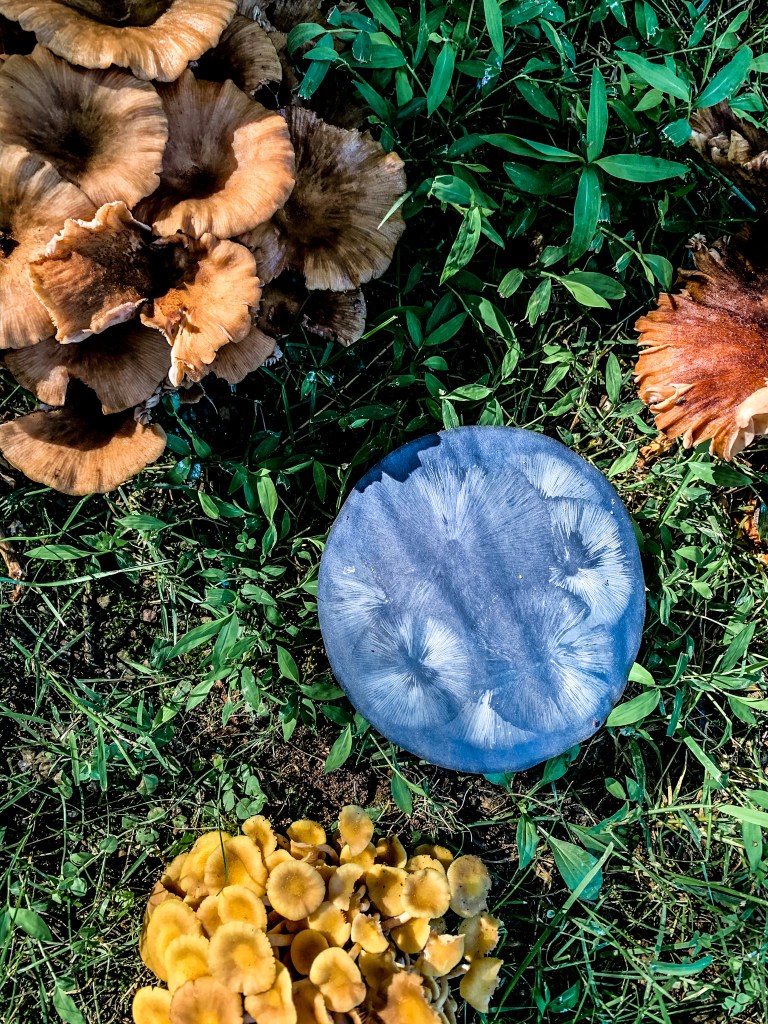
Spore prints are best made from fresh mushrooms found outdoors. They are a stunning way to observe and study nature. Learn how to gather, print, and preserve these delicate pieces of art.

Spore prints from mushrooms found outdoors are an easy and beautiful way to study nature.

Mushrooms are fascinating. They are pervasive in folklore and iconography, and evoke feelings that range from unnerving to adorable. I was once intimidated by mushrooms. I didn’t want to touch them and I was scared that my children would eat one. Then I moved to a property that was speckled with hundreds of mushrooms come the end of summer. Every step, we could point out a new variety and it was interesting and frightening and I was drawn in.

I decided that, like many other fears I’ve had in my life, the best way to deal with it is to learn more and study it. One of the first projects I did was taking spore prints because it required me to face my fear and touch them. Now after borrowing many books from the library, exposing myself to the world of mushroom hunting, and strolling our property for mushrooms every night in the late summer, I have a deep respect and mild obsession with these organisms. Let’s learn a bit about them.

Continue reading “Spore Prints”

Radioactive Fiestaware

Would you like some uranium with your tea?

From 1936-1972, the makers of Fiestaware (and also many other ceramics from that time) used uranium oxide in the glaze to get certain colors, the most common of which is a brilliant redish-orange. This however made the dining sets radioactive.


Production lines initially used uranium from natural sources, which contains a mix of uranium-238 and uranium-235, but during World War II, the US government seized uranium supplies around the country to collect the U-235 for use in atomic weapons. After the war, the ceramics were glazed with “depleted” uranium oxide, which has a smaller percentage of U-235 and therefore “depleted” of the more coveted form of uranium. Eventually, other glazes were developed and uranium oxide was no longer needed to achieve certain colors, but many sets are still available in second-hand markets around the world.

When something is “radioactive,” we are usually referring specifically to ionizing radiation, which is when high energy particles are emitted from an unstable element. Our bodies are bombarded with radiation everyday, coming from sources like cosmic rays from space or the granite in buildings. These, and many other types of exposures, are no cause for concern and are just a normal part of living on earth. Scientists called Health Physicists have studied levels of radiation exposure that are acceptable to humans (i.e. no increase in cancer risk or acute effects) and old, orange Fiestaware use falls into this category. The uranium oxide is encased in the glaze, so although your skin is exposed to the radiation, you will not ingest any, assuming the finish is not cracked.


If youโ€™ve been dreaming of teaching your kids about radioactivity, check out Nuclear Physics for Babies for their first taste of this wild subject. ๐Ÿ˜‰

Sources:

Oak Ridge: https://www.orau.org/ptp/collection/consumer%20products/fiesta.htm

EPA: https://www3.epa.gov/radtown/antiques.html

Landa, E. and Councell, T. Leaching of Uranium from Glass and Ceramic Foodware and Decorative Items. Health Physics 63 (3): 343-348; 1992.

Piesch, E, Burgkhardt, B, and Acton, R. Dose Rate Measurements in the Beta-Photon Radiation Field from UO2 Pellets and Glazed Ceramics Containing Uranium. Radiation Protection Dosimetry 14 (2): 109-112; 1986.